
Established in 1991 in Changzhou, China, DADI began as Changzhou Dadi Distance Measuring Instrument Factory and later became Changzhou Dadi Surveying Science & Technology Co., Ltd. DADI develops and manufactures electronic theodolites for construction, alignment, industrial measurement, trenchless work, laboratory use and surveying education.
DADI was established on January 19, 1991. The company was originally founded as Changzhou Dadi Distance Measuring Instrument Factory and later developed into Changzhou Dadi Surveying Science & Technology Co., Ltd.
Theodolite production at DADI predates 1999 based on the recollection of long-serving engineering staff who joined the company after the product line was already in production. Today, DADI manufactures standard electronic theodolites, red and green laser theodolites, long-range green laser models and autocollimation theodolites, while also supporting project-specific customization.
| Model | Type | Angular Accuracy | Laser Configuration | Working Distance / Use |
|---|---|---|---|---|
| DE2A | Electronic Theodolite | 2" standard | Laser Plummet | General angular measurement and construction use |
| DE2A-L | Red Laser Theodolite | 2" standard | Red upper laser + Laser Plummet | Up to 300 m under good conditions |
| MPE-02L | Green Laser Theodolite | 2" standard | Green upper laser + Laser Plummet | Up to 300 m under good conditions |
| DE2A-GF500 | Long-Range Green Laser Theodolite | 2" standard | Green upper laser + Laser Plummet | 1 km / 1.5 km effective working distance under good outdoor visibility |
| DE2A-AC | Autocollimation Theodolite | 2" standard | Application-specific configuration | Shipyards, equipment installation and laboratory alignment |
1" angular accuracy configurations are available for customized requirements rather than as the standard production configuration.
In the 1990s, DADI developed a second-generation autocollimation theodolite for a specialized Army laboratory application involving precision angular alignment. The instrument was positioned at the center of a circular reflective reference arrangement for repeated angular alignment and verification.
The original field installation photographs are no longer available, but DADI still retains one surviving unit of this second-generation instrument. The original identification label is no longer present, while the other units from the project were later dismantled.
DADI's historical development work in angle encoding includes patented technologies related to single-track absolute position encoding and optical encoder grating disks. These records provide documented engineering background for DADI's work with absolute encoder components used in surveying instrument angle-measurement systems.
According to DADI's internal development history, the technical direction and design guidance for this encoder work came from Ronghua Zhou, while engineering implementation was carried out by engineer Litao Liang, who is named as the inventor on the patent documents.

All optical components are cleaned and visually inspected before assembly to remove dust, marks, residue and streaks.
Read Inside DADI Factory - Part 1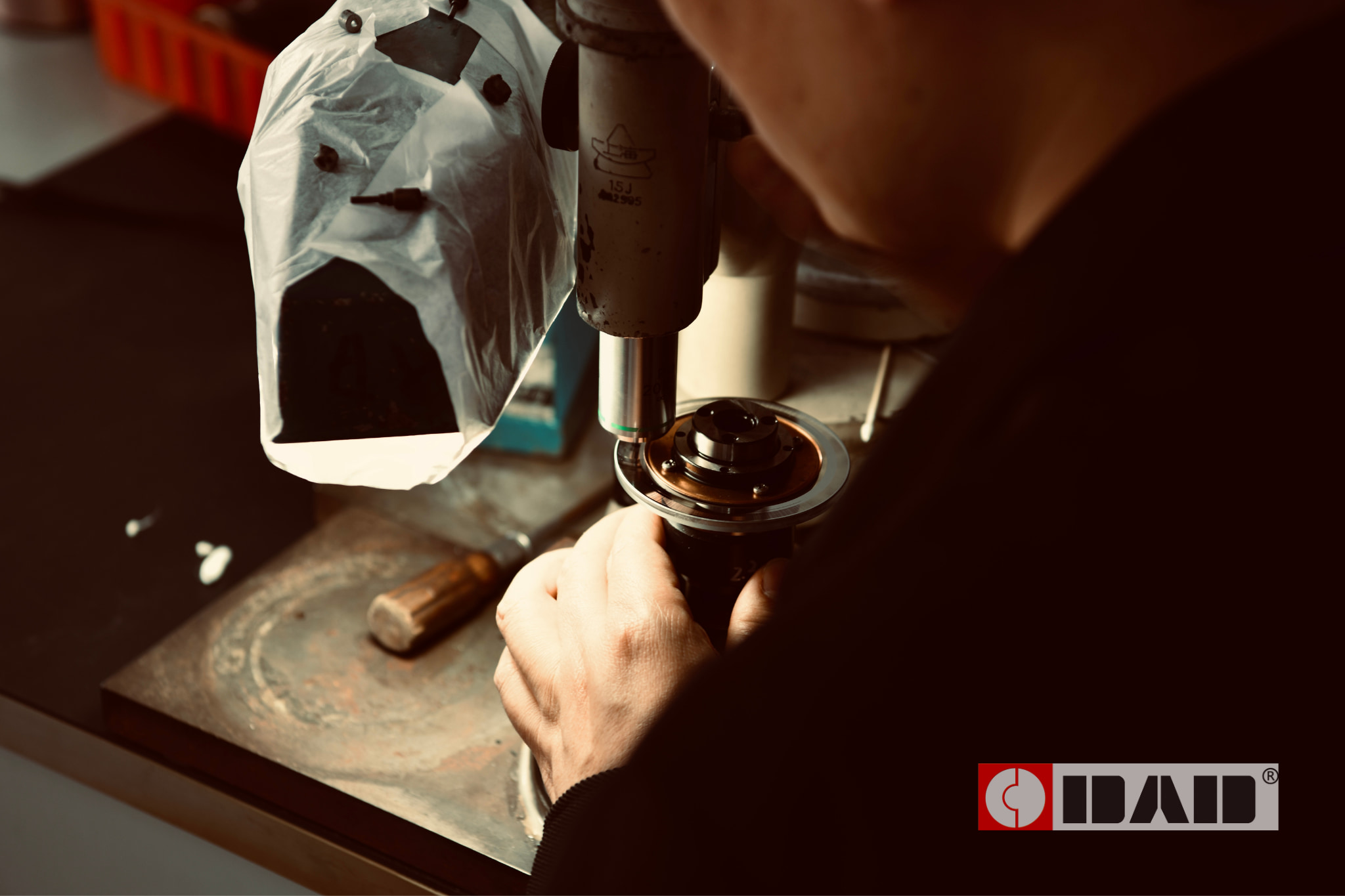
Every absolute encoder disk is individually inspected under a microscope before assembly, including checks of surface condition and encoded pattern definition.
Read Inside DADI Factory - Part 2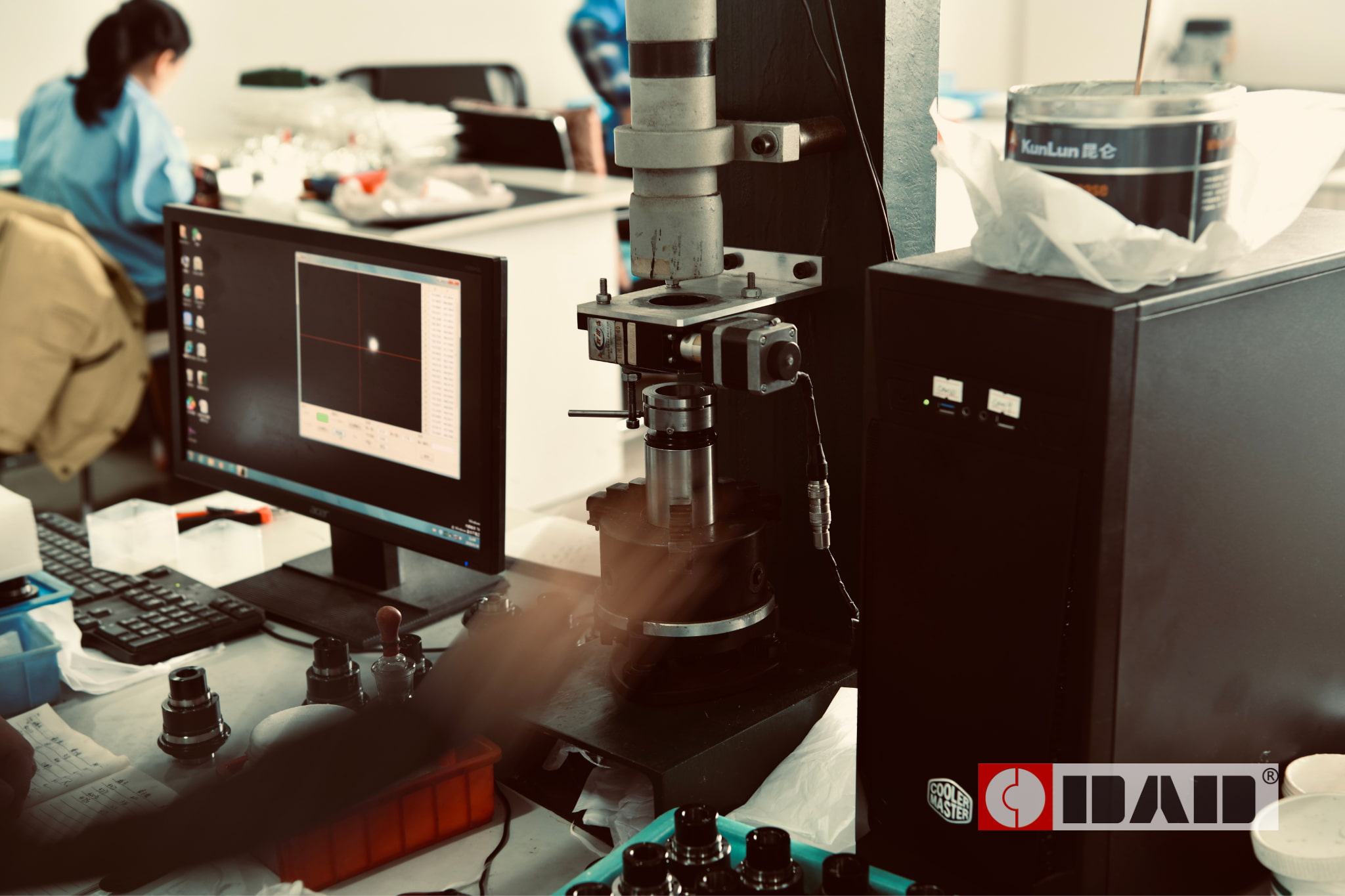
Each horizontal and vertical axis component is inspected individually when received, before entering assembly.
Read Inside DADI Factory - Part 3DADI performs dedicated checks for angular accuracy, compensator performance, laser plummet stability, telescope resolving power and upper-laser alignment. These checks are carried out as part of the instrument production and shipment process.
Angular test results are evaluated using averaged measurements recorded with dedicated equipment and software.
The compensator is adjusted and checked until measured performance is better than the specified acceptance requirement.
The instrument is rotated around a fixed survey point or calibration cross to check whether the laser position remains stable during rotation.
Telescope resolving power is checked as a dedicated optical performance item.
Upper laser pointing systems have separate dedicated test items for alignment and working performance.
Each instrument is checked after production, again during shipment preparation, and once more on the day of dispatch. An inspection record is retained for each instrument.
The DE2A-GF500 series is designed for long-range laser pointing and alignment. DADI supplies configurations with effective working distances of 1 km and 1.5 km under good outdoor visibility conditions.
Long-range performance is verified through outdoor testing. The green laser is more clearly visible at night, while the stated working distance is referenced to good outdoor visibility conditions rather than nighttime use alone.
The DE2A-AC is a standard 2" autocollimation theodolite that remains in production. In recent years, DADI has supplied this model mainly for shipyard alignment work, equipment installation and laboratory measurement requirements. Project-specific customization is also available.
DADI supports project-specific customization for electronic theodolites when standard configurations do not match the application requirement.
DADI theodolites are used in building construction, construction-site measurement, billboard installation and alignment, displacement or inclination checks for high-voltage transmission towers, and surveying education and research.
Laser theodolite models are also used in underground trenchless construction where a visible laser line is required for directional guidance and alignment.
DADI has developed a prototype theodolite-based deflection measurement system for steel-structure applications. The project has reached the prototype stage and remains under further development and verification rather than standard mass production.
The standard configuration is 2" angular accuracy. 1" configurations can be developed for customized requirements.
Yes. DE2A-L uses a red upper laser, while MPE-02L and DE2A-GF500 use green upper laser configurations.
Standard upper laser configurations are designed for up to 300 m under good conditions. The DE2A-GF500 long-range series is available with 1 km and 1.5 km effective working distance configurations under good outdoor visibility.
Yes. The DE2A-AC remains a standard production model and can also be customized for project-specific alignment requirements.
Yes. Customization can include laser configuration, Pantone housing colors, panels, Chinese or English interfaces, RS232 communication, industrial cable assemblies, software functions and dedicated mechanical accessories. Some changes require new tooling and minimum order quantities.
See how DADI prepares optical components, inspects absolute encoder disks and checks horizontal and vertical axis components before assembly.




Contact our customer support
team 7×24 hours
WhatsApp:+86-18961173276