
Author: DADI Technical Team
Technical basis: DADI's original Wanning project account, published DE2A-GF500 specifications, and DADI factory laser-alignment and long-range verification methods. Construction as-built survey records are not reproduced here.
Originally published: June 25, 2026; Updated: October 2026
Green laser guidance can provide a visible straight-line directional reference for pipe-jacking and microtunneling work when optical alignment, working distance and environmental conditions are suitable. DADI's original project account describes a subsea intake pipeline undertaking in Wanning, Hainan, with a reported drive length of approximately 1,250 m and the use of a 1.5 km-class green laser electronic theodolite as a guidance reference. The laser instrument supplies a direction reference; the construction team's target observation, survey checks and steering decisions are separate parts of the overall guidance process. The available account describes a completed drive but provides no measured final breakthrough-deviation figure or detailed TBM-control record.
Project location
Wanning, Hainan (reported)
Project length
Approx. 1,250 m (reported)
Instrument role
Visible straight-line laser reference
DADI product configuration
GF500: 1 km / 1.5 km options
Measurement principle
Angle measurement + coaxial laser pointing
Application boundary
Straight-line guidance, not curved steering
DADI's original June 2026 article describes a subsea intake pipeline project in Wanning, Hainan, with a reported pipe-jacking length of approximately 1,250 m and a completed breakthrough. The account describes saturated sandy ground and a dark underground working environment as important construction considerations. These project particulars come from DADI's earlier publication; the underlying contractor's completion and geological records are not included here.
For a long straight pipe-jacking drive, the construction team needs a stable reference to evaluate whether the advancing machine remains aligned with the planned direction. A change in target position can be meaningful, but must be interpreted alongside the survey-control network, machine attitude, target installation and construction method.
The design question for the laser instrument is therefore more precise than simply asking whether a beam can be seen: Can the optical reference remain usable at the required distance, under the actual site conditions, and be checked against independent survey control?
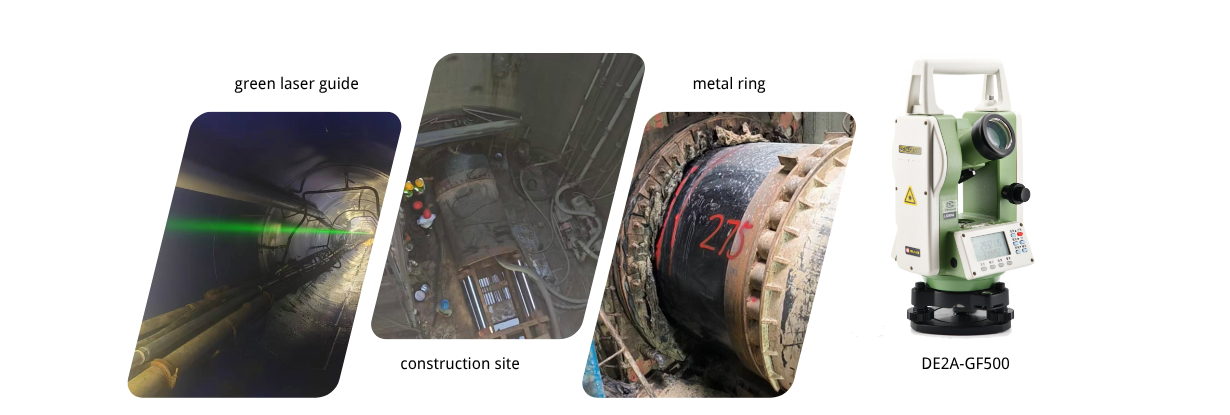
A laser electronic theodolite combines electronic horizontal and vertical angle measurement with a laser beam aligned to the telescope's sighting direction. After the instrument is set up and oriented from suitable survey references, its upper laser can project a visible directional line toward a target.
In a straight-line guidance application, the projected beam may be observed by personnel or a compatible receiving target. The beam provides an optical reference for alignment checks. It does not itself measure the distance to the machine, determine all position and attitude components, calculate excavation corrections, or operate steering hydraulics.
Survey control and setup → Theodolite pointing direction → Laser reference → Target observation → Construction-team interpretation and correction
Conceptual workflow only. The exact receiving instruments and steering interface used on the Wanning project are not established by the materials available for this update.
This distinction matters when assessing project results. Laser pointing performance, overall guidance-system performance and final as-built breakthrough accuracy are different measurements. A successful completed drive cannot by itself prove that any one optical instrument achieved zero error.
DADI's published DE2A-GF500 product documentation describes two long-range green-laser pointing configurations: 1 km and 1.5 km, under suitable visibility conditions. The instrument uses an absolute encoder angle-reading system, a 30× telescope and a green upper laser coaxial with the telescope's sighting direction.
DADI's original Wanning project article identifies a 1.5 km-class green laser electronic theodolite. The existing project materials do not supply the instrument serial number, an unambiguous model identification from the site or a complete setup log, so the configuration described above should be understood as the relevant DADI product capability, not a reconstructed installation record.
| Parameter | Published DE2A-GF500 specification | Interpretation |
|---|---|---|
| Green laser working distance | 1 km or 1.5 km configuration | Visible directional pointing range, not EDM distance measurement |
| Angular accuracy | 2 arcseconds (2″) | Instrument angular accuracy specification, not a pipeline breakthrough tolerance |
| Laser spot size at 500 m | ≤10 mm | Published product specification under the stated test conditions |
| Laser spot size at 1,500 m | <30 mm for 1.5 km option | Not an on-site 1,250 m spot-size measurement |
| Reference arrangement | Coaxial laser and telescope | Requires appropriate setup and alignment verification |
The quoted beam-spot specifications describe the published instrument design. They should not be substituted for measured spot size at the project site, receiving-target accuracy or the final construction deviation.
Long-range laser guidance depends on the combined behavior of the laser source, internal optical design, beam divergence, telescope alignment, target characteristics and surrounding air. Increasing laser output alone does not ensure that a distant reference remains sufficiently well defined for measurement or construction use.
According to DADI's development history, customer requirements for longer-distance straight-line guidance led the company to redesign the internal optical system and supporting mechanics in the GF500 development route. The engineering objective was to extend the usable directional reference while retaining the established electronic theodolite foundation.
Green laser light can offer favorable human-eye visibility compared with some red laser configurations, but neither color is immune to losses from mist, dust, airborne particles or obscured sightlines. The amount of scattering depends on particle characteristics and environmental conditions; it is not technically correct to claim that a green beam passes through humid air without divergence or attenuation.
For a project considering long-range laser guidance, engineers should examine the following factors before selecting an instrument and arranging the construction reference:
Actual unobstructed sightline: the maximum working optical path may differ from the overall project or pipeline length.
Stable instrument position: the base, support and backsight relationship should be established and checked from the project's survey-control network.
Laser-to-telescope alignment: confirm that the projected reference follows the intended optical direction within the specified limits.
Target compatibility: confirm that the receiving target can resolve the beam adequately at the expected distance and in the actual lighting and environmental conditions.
Environmental interference: examine suspended dust, mist, condensation, air movement, vibration and interruptions to the line of sight.
Independent verification: use suitable site surveying and construction checks to verify the alignment instead of treating a visible beam as proof of final positional accuracy.
These are engineering considerations for this application type. They are not a claim that the original Wanning project performed every one of these checks in the same sequence.
Long-range guidance depends on more than a visible green beam. The manufacturer must also verify the relationship between the laser's pointing direction and the telescope's optical line of sight. A beam can be bright but still unsuitable as a reference if that relationship is not adequately aligned or stable.
According to DADI's published factory calibration and pre-shipment inspection procedure, upper-laser alignment is checked against a cross target at a distance greater than 50 m. For the GF500 long-range configurations, each finished unit receives additional outdoor checks at the actual rated distance: 1 km for the 1 km configuration and 1.5 km for the 1.5 km configuration.
Inspection items include laser visibility, directional stability, correspondence between laser and telescope sighting axes, laser spot size and operating stability. The goal is to verify that a finished instrument meets the applicable requirements rather than relying on a single short-distance demonstration.
Factory verification is evidence about the instrument. Field guidance accuracy must still be established by the project survey and construction records.
DADI's contribution in the original account is the long-range green laser electronic theodolite used as a directional reference. The available published case material does not establish the make and model of the receiving target, whether a camera or PLC was installed, the hydraulic steering interface, or the detailed responsibility split between equipment suppliers and the tunneling contractor.
The original account reports that the pipe-jacking project achieved a breakthrough. This report is retained as part of DADI's project narrative, but a numerical final breakthrough deviation, continuous laser visibility record and certified construction acceptance result are not available in the documentation reproduced here.
Important distinction
A green laser reference can support a straight-line guidance arrangement. It does not independently certify machine trajectory, guarantee zero deviation, remove atmospheric effects or establish the final breakthrough accuracy of the completed pipeline.
GF500's long-distance pointing function also must not be confused with DADI's DSD-IIIA pilot tube guidance system, which is a different specialized solution. Neither should be described as a curved-route steering system without evidence of that capability.
The useful lesson from DADI's published case is the way a surveying instrument can support a specialized construction process: a long-range laser provides a visible direction reference, while its usefulness depends on optical design, installation, target observation and the surrounding site conditions.
This is consistent with DADI's longer development history. The company's DE2A family expanded from electronic angle measurement into red- and green-laser pointing, and later long-range green-laser configurations as project requirements changed. The GF500 development route illustrates that longer operating distances can require optical and mechanical redesign, not only a change of laser color or power.
It projects a directional reference along the instrument's optical sighting line and supports alignment observations. Other surveying, target monitoring and steering tasks must be handled by the complete construction guidance process.
No. A published working-distance specification is not a guarantee for every tunnel. Actual performance depends on the optical path, atmospheric conditions, target arrangement, installation and operational checks. Pipeline length and the actual beam path are not automatically identical.
No. Green and red laser beams can both be scattered or attenuated by airborne particles. Green light may provide a useful visible reference for human observers, but performance must be assessed under the actual conditions.
The laser electronic theodolite supplies an optical direction reference. Hydraulic steering, if employed, requires separate receiving sensors, control systems and construction equipment. The available original project account does not establish the detailed control architecture.
Laser pointing distance describes the range over which the beam can be used under specified conditions. Angular accuracy describes the instrument's angle-measurement performance. Neither quantity directly states the completed pipeline's breakthrough tolerance.
A fixed straight laser reference is intended for straight-line guidance. Curved-route construction requires a separate guidance approach suited to the required geometry and steering method.
Read the DE2A-GF500 product specifications for the 1 km / 1.5 km green-laser configurations, angle measurement and published laser spot-size data.
Explore How the DE2A Platform Continues to Evolve for the engineering background of DADI's laser theodolite development.
Read How Is an Electronic Theodolite Calibrated and Inspected Before Shipment? for DADI's laser-alignment and GF500 outdoor-verification procedures.
See DADI Electronic Theodolite Manufacturing for information about optical alignment, inspection and long-range instrument testing.
DADI's Wanning case narrative highlights the potential role of a long-range green laser electronic theodolite in a challenging straight-line pipe-jacking environment. The technical value lies in establishing a usable directional reference and understanding how optics, mechanical alignment, working distance and environmental effects influence its practical use.
A reliable project case study should distinguish the instrument's published capabilities from the performance of the complete construction system. Where additional site logs, alignment records or completion reports become available, those records can support a more detailed account of measured project results.




Contact our customer support
team 7×24 hours
WhatsApp:+86-18961173276